
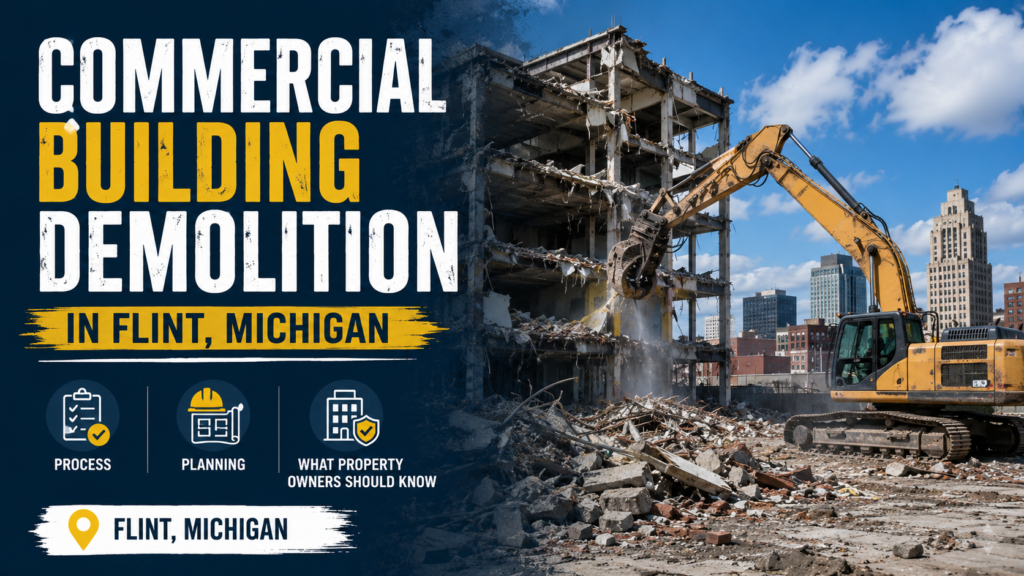
Commercial Building Demolition Flint is a complex, multi-phase undertaking that goes far beyond simply knocking a structure down. In Flint, Michigan a city with a significant inventory of aging commercial and industrial properties demolition is a frequent and necessary step in the cycle of urban redevelopment. Whether a building has outlived its useful life, suffered structural damage, is part of a broader blight remediation effort, or needs to be cleared to make way for new development, understanding the demolition process helps property owners, developers, and community stakeholders approach these projects with realistic expectations.
Why Commercial Demolition Is Different from Residential
While residential demolition typically involving single-family homes or small multifamily structures is a relatively straightforward operation, commercial demolition involves significantly greater complexity. Commercial buildings are larger, often have more complex structural systems, may contain a wider range of hazardous materials, and are more likely to be located in densely built areas with adjacent occupied properties.
Commercial demolition in Flint can involve warehouses, retail buildings, office complexes, manufacturing facilities, and institutional structures. Each type has its own structural characteristics, material composition, and regulatory considerations that shape how the demolition must be planned and executed.
Phase 1: Pre-Demolition Assessment and Planning
Before any physical work begins on a commercial demolition project in Flint, a thorough pre-demolition assessment is required. This phase involves:
- Structural assessment: Engineers evaluate the building’s construction type, materials, and structural condition to determine the safest and most efficient demolition approach.
- Hazardous materials survey: Buildings constructed before the 1980s may contain asbestos, lead paint, or other regulated materials. A licensed environmental inspector surveys for these materials before demolition begins. Under the Asbestos Hazard Emergency Response Act (AHERA), anyone working with asbestos-containing building materials in a commercial structure must be EPA-certified.
- Utility disconnection: All utilities serving the building electricity, gas, water, and sewer must be formally disconnected and verified by the respective utility companies before demolition can proceed.
- Permitting: Commercial demolition in Flint requires permits from the City of Flint building department and may require coordination with state agencies depending on the size and nature of the project.
Hazardous Material Abatement
One of the most regulated and consequential aspects of commercial demolition is the abatement of hazardous materials prior to structural demolition. Asbestos was widely used in commercial construction until the late 1970s and early 1980s and can be found in insulation, floor tiles, ceiling tiles, roofing materials, pipe insulation, and fireproofing compounds.
Lead paint is present in many older commercial buildings and must be handled by certified abatement professionals following EPA guidelines. Other regulated materials may include mercury-containing equipment, PCBs in older electrical transformers, and various chemicals stored in industrial or manufacturing facilities.
Abatement must be completed before mechanical demolition begins and must be performed by licensed contractors who follow specific containment, removal, and disposal protocols. Proper abatement protects workers, neighboring properties, and the broader community from hazardous material exposure.
Demolition Methods Used in Commercial Projects
Several demolition methods may be employed depending on the building’s size, location, and structural characteristics:
- Mechanical demolition: The most common method in Flint’s commercial demolition sector. Heavy equipment including excavators with specialized attachments, wrecking balls, and high-reach demolition machines are used to break down the structure in a controlled, sequential manner.
- Selective demolition: Used when portions of a structure are to be retained or when materials are being salvaged for reuse. This method requires more precision and time but can recover valuable materials.
- Explosive (implosion) demolition: Reserved for large structures where the geometry and surrounding conditions are appropriate. Explosives are strategically placed to cause the structure to collapse inward. This method is rarely used in urban Flint due to proximity to adjacent structures.
- Deconstruction: A labor-intensive process of manually dismantling a building to maximize material recovery. While more time-consuming, deconstruction can recover significant quantities of reusable materials.
Debris Management and Material Recycling
A typical commercial demolition project generates thousands of tons of material concrete, steel, masonry, wood framing, glass, and miscellaneous building materials. Responsible demolition contractors in Flint have well-developed processes for sorting and recycling these materials.
Steel and metal are highly recyclable and typically the most economically valuable recovered material. Concrete can be crushed and processed into recycled aggregate suitable for use as road base or fill material. Wood framing from older structures may be suitable for salvage and reuse. Responsible demolition significantly reduces the volume of material going to landfill and can partially offset project costs through material recovery.
Site Clearing and Grading After Demolition
Once the structure is demolished and debris is removed, the site must be graded and prepared for its next use. This involves removing the concrete foundation (if not retained for reuse), filling any excavated areas, grading the site to appropriate drainage standards, and in some cases, applying topsoil or erosion control measures to stabilize the ground until development proceeds.
In Flint’s urban context, many post-demolition sites are part of larger neighborhood improvement programs, and proper site grading ensures they become assets rather than hazards to surrounding properties.
Community Impact and Urban Revitalization
Commercial building demolition in Flint has direct implications for community safety and revitalization. Abandoned commercial buildings that are structurally compromised pose risks of collapse, fire, and criminal activity. Their removal eliminates these hazards and creates opportunities for redevelopment that can bring economic activity, housing, or green space to areas that need it.
From an urban planning perspective, strategic demolition of non-salvageable commercial structures is a recognized tool in the revitalization of post-industrial cities, and Flint has made significant investments in using demolition as a catalyst for neighborhood renewal.
Conclusion
Commercial building demolition in Flint is a technically complex, heavily regulated, and community-significant undertaking. From the pre-demolition hazardous materials survey through the final site grading, each phase requires skilled professionals, proper permitting, and responsible material handling. Property owners, developers, and community organizations approaching commercial demolition projects benefit greatly from understanding the full scope of what the process involves not just the physical act of bringing a building down, but the careful planning, regulatory compliance, and site restoration that make a demolition project a genuine step forward for the community.